STArK: Towards Synthesizing Articulatory Kinematics from Text
Language Technologies Institute, Carnegie Mellon University · Interspeech 2026
Abstract
Recent deep learning approaches in modeling articulatory kinematics have shown success in mapping speech audio to electromagnetic articulography (EMA) kinematics, but these methods are limited by the scarcity of high-quality articulatory datasets. We introduce synthesizing text to articulatory kinematics (STArK), which offers a novel approach in generating articulatory kinematics directly from text. We train STArK on the LibriTTS-R dataset with pseudo-labeled EMA features derived from a pre-trained speech-to-articulation model. STArK is the first model to demonstrate high-quality articulatory kinematics generation from text. STArK achieves comparable performance to existing multi-speaker text-to-speech models at speech synthesis, while supporting voice cloning without seeing speaker embeddings during training. STArK aims to enable the generation of scalable articulatory data from text corpora for downstream tasks.
Method
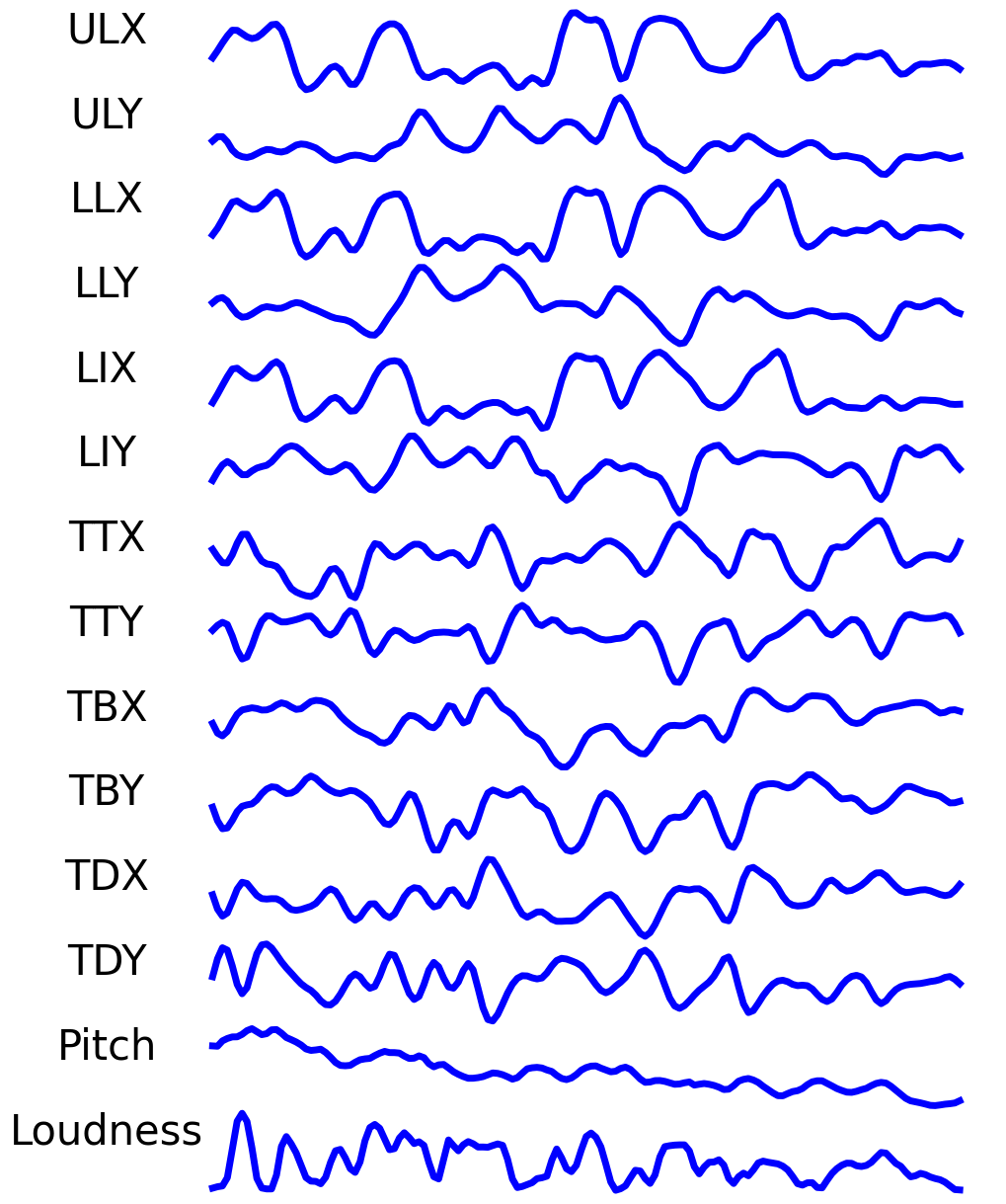
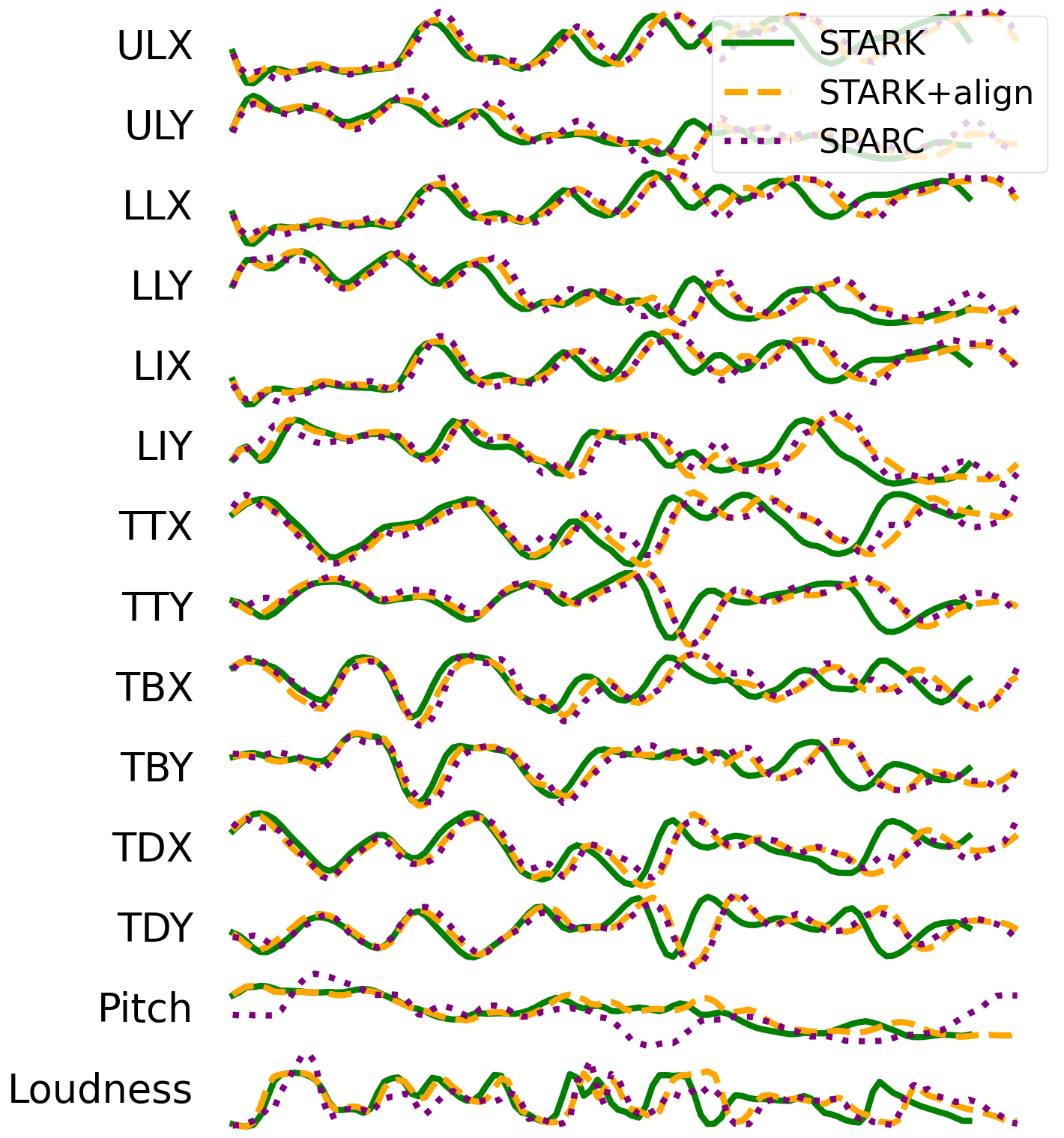
STArK follows a non-autoregressive text-to-articulation (TTA) pipeline: a Phonemizer/eSpeak-NG front-end converts text to phonemes, an FFConformer Text Encoder with rotary positional embeddings produces phoneme representations, an unsupervised aligner (adapted from One TTS Alignment) and duration predictor regulate timing, and an FFConformer Articulatory Decoder predicts 12 EMA channels plus pitch and loudness — the SPARC feature space. A frozen SPARC vocoder then resynthesizes speech from the predicted articulatory kinematics, using a reference speaker embedding for voice cloning — STArK itself never sees speaker embeddings during training.
Results
STArK was trained on LibriTTS-R train-clean-100 for 32,000 steps (~96 hours on
4 L40S GPUs), and evaluated on test-clean. Setup (1) uses
predicted durations (full text-to-speech inference); + aligner (Setup 2)
substitutes aligner-generated durations; + prosody (Setup 3) additionally
substitutes ground-truth pitch/loudness from SPARC, isolating text-to-articulation accuracy
from prosody prediction.
| Model | DNSMOS P.808 ↑ | SIG ↑ | BAK ↑ | OVR ↑ | UTMOSv2 ↑ | NMOS ↑ | SECS ↑ | WER ↓ |
|---|---|---|---|---|---|---|---|---|
| GT | 3.71±0.01 | 3.465±0.007 | 3.925±0.008 | 3.135±0.009 | 3.25±0.01 | 3.9±0.4 | 1.000 | 2.39 |
| SPARC | 3.77±0.01 | 3.543±0.005 | 4.024±0.006 | 3.240±0.007 | 3.03±0.01 | 3.7±0.3 | 0.493±0.006 | 3.31 |
| STArK | 3.71±0.01 | 3.504±0.006 | 3.902±0.009 | 3.142±0.009 | 2.97±0.01 | 2.8±0.6 | 0.426±0.005 | 6.25 |
| + aligner | 3.84±0.01 | 3.540±0.005 | 3.983±0.007 | 3.216±0.008 | 2.85±0.01 | 2.9±0.4 | 0.446±0.005 | 6.30 |
| + prosody | 3.79±0.01 | 3.537±0.005 | 4.006±0.006 | 3.224±0.007 | 3.03±0.01 | 3.3±0.3 | 0.478±0.006 | 6.01 |
| YourTTS | 3.81±0.01 | 3.568±0.005 | 4.100±0.004 | 3.307±0.006 | 2.80±0.01 | 2.0±0.5 | 0.410±0.005 | 4.58 |
Despite training on far less data than YourTTS and never seeing speaker embeddings during training, STArK is competitive on DNSMOS and outperforms YourTTS on speaker similarity (SECS) — attributable to SPARC's speaker–content disentanglement.
| Feature | PCC ↑ | ΔDTW ↓ |
|---|---|---|
| EMA | 0.905±0.001 | −0.81±0.09 |
| Pitch | 0.533±0.009 | −0.04±0.04 |
| Loudness | 0.796±0.002 | −0.20±0.06 |
Paper samples
The supplementary audio released with the paper, taken from the original
STArK paper demo. Both samples are
LibriTTS-R test-clean utterances (1089_134691_000014_000001 and
1284_1180_000050_000001), corresponding to the systems in Table 1. They were
generated with the paper's step-32,000 checkpoint, not the step-100,000 checkpoint used for
the demo samples below.
Audio samples
| Model | Sample 1 | Sample 2 |
|---|---|---|
| Ground truth | ||
| SPARC resynthesis | ||
| YourTTS | ||
| STArK (ours) |
Duration and prosody ablations
| Model | Sample 1 | Sample 2 |
|---|---|---|
| Base STArK | ||
| STArK w/ aligner durations | ||
| STArK w/ aligner durations + GT prosody |
Demo samples
Generated with scripts/stark_cli.py
using the fully-trained checkpoint (step 100,000 — verified against the paper's Table 1/2
results, see README).
Unseen text
Sentences not drawn from any dataset. Each sample clones a different LibriTTS-R
test-clean speaker's voice from a short reference clip — the reference clip's
spoken content is unrelated to the synthesized sentence; it's shown only to demonstrate the
voice being cloned.
"Hello there."
"The quick brown fox jumps over the lazy dog."
"Articulatory kinematics describes how the tongue, lips, and jaw move during speech production."
Test-set text
Sentences drawn directly from LibriTTS-R test-clean transcripts, cloning that
same utterance's speaker — paired against the actual ground-truth recording of the same
sentence for direct comparison.
"Reference has already been made to the work abroad in Paris and London."
"I'd like it first rate to be away from Percy," said Van, reflectively; "I wouldn't come back in three, no, six weeks."
"The people contested these measures one by one in the courts; presenting in case after case the different phases of the subject, and urging the unconstitutionality of the measure."
Citation
@inproceedings{yin2026stark,
  title     = {{STArK: Towards Synthesizing Articulatory Kinematics from Text}},
  author    = {Xavier Yin and Carlos Busso},
  year      = {2026},
  booktitle = {{Interspeech 2026}},
  pages     = {6542--6547},
  doi       = {10.21437/Interspeech.2026-2842},
  issn      = {2958-1796},
}
STArK builds directly on SPARC (Cho et al.) — see the repository license for the SPARC citation requirement.